Home » Pipeline
Orion Biotechnology is developing chemokine analogues to address unmet needs in oncology, neuroinflammation, and infectious diseases. We are able to generate highly selective and potent molecules that are designed to disrupt the chemokine / chemokine receptor interactions that underly these diseases.
Pre-Clinical
Phase 1 Trial
Pre-Clinical
Discovery
Discovery
Clinical Trials
Phase 1 Phase 2 Phase 3
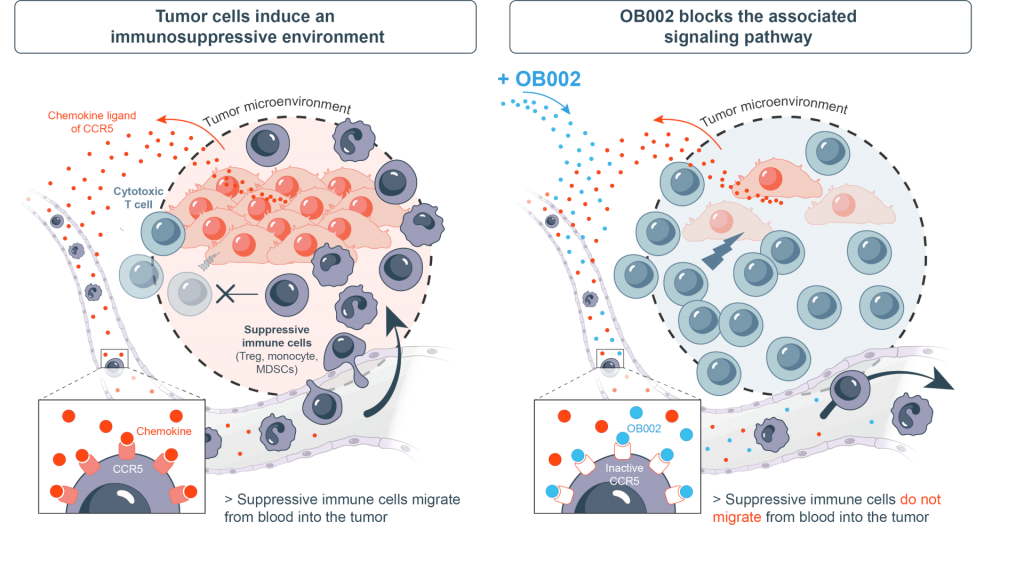
A fundamental role of chemokines is to orchestrate the movement of immune cells around the body in response to inflammation and injury. However, the interaction of chemokines and their receptors may also play an important role in cancer. Chemokines secreted by tumour cells or by normal cells recruited to tumour sites can behave as growth factors, increase metastasis and angiogenesis, or contribute to the creation of an immunosuppressive environment that supports tumour growth. There is increasing interest in modulation of the CCL5 (RANTES) ligand/CCR5 receptor axis as a strategy to treat cancer. Cancer cells can secrete CCL5 or induce fibroblasts to secrete CCL5, which sustain the proliferation of CCR5-positive tumour cells, recruit T-regulatory cells and monocytes with suppressive functions, cause osteoclast activation. There is increasing pre-clinical and clinical evidence that CCR5 antagonism, given as monotherapy or in combination with other immunotherapeutic agents, can inhibit tumour growth and metastasis.
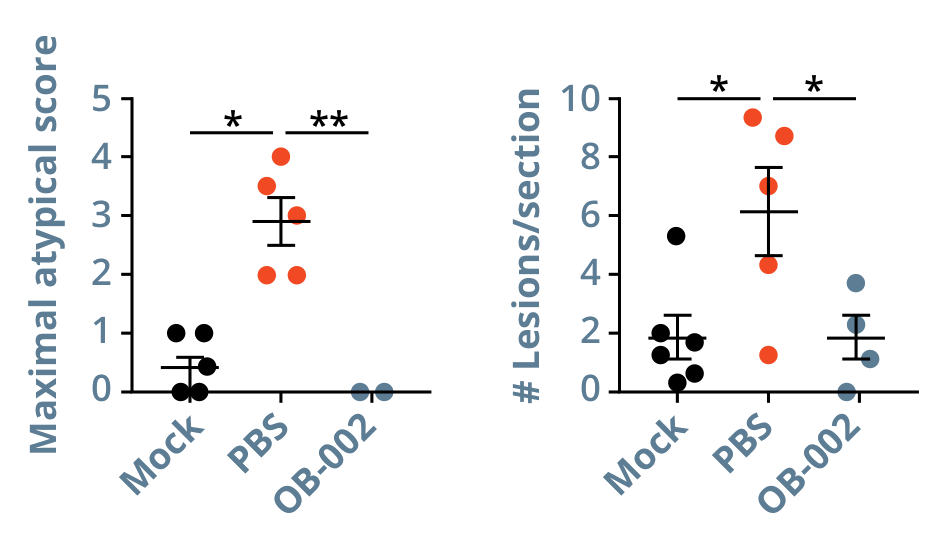
The CCR5 receptor is expressed on a range of cells within the central nervous system including microglia, neurons, and astrocytes. During infection or autoimmune reactions, these same cell populations express ligands to CCR5 (CCL3, CCL4, and CCL5). Consequently, the CCR5/CCL5 axis is thought to play an important role in a range of neurological diseases including multiple sclerosis, Rasmussen encephalitis, progressive multifocal leukoencephalopathy-associated immune reconstitution inflammatory syndrome, cerebral malaria, HIV-associated neurocognitive disorders, and stroke recovery. In animal models, exposure to CCR5 antagonists appears to partially reverse CNS inflammation and OB-002 has had a similar effect in a mouse model of autoimmune brain inflammation.
Results from a mouse model of multiple sclerosis (MS) showing that OB-002 can reduce disability (atypical score) and the number of intracerebral MS lesions (Steinbach K et al. Science Translational Medicine 2019)
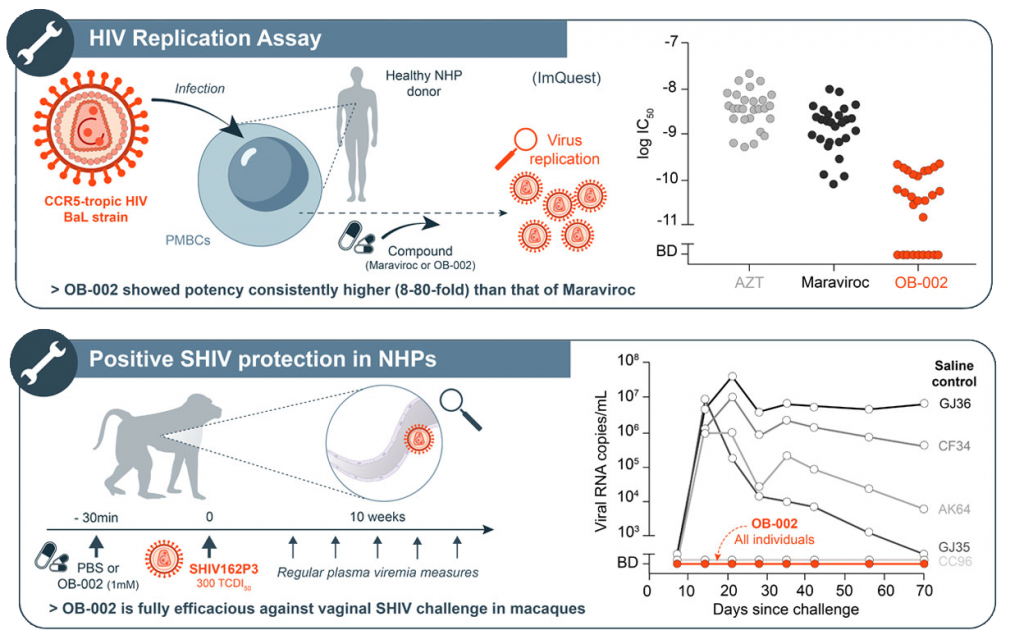
CCR5 is one of the two co-receptors that HIV uses to infect target cells. Individuals who carry a genetic defect that results in a truncated non-functioning CCR5 receptor are highly protected from HIV infection as initial HIV infection is usually mediated by viruses that selectively target CCR5. Because of this finding, CCR5 antagonists have been developed for the treatment of HIV infection and are being evaluated for HIV prevention. Among the currently available CCR5 antagonists, OB-002 has best-in-class in vitro potency and was able to completely prevent infection in a non-human primate model of HIV infection. A Phase 1 safety and acceptability study of a topical formulation of OB-002 is currently being conducted in Poland.
OB-003 is a chemokine analog of CCL25 that targets the CCR9 chemokine receptor. The CCR9 receptor facilitates leukocyte trafficking into the intestinal mucosa. A CCR9 receptor that has been activated by its specific ligand is involved in tumor chemoresistance and metastasis, and targeted antagonism of the CCR9 receptor could play a critical role in treating cancer metastasis. The mechanism of CCR9 is also implicated in the pathogenesis of Inflammatory Bowel Disease (IBD), and OB-003 as a CCR9 antagonist has the potential to block migration of inflammatory cells into the intestinal mucosa and reduce the inflammation seen in patients with IBD. The development of safe and highly potent chemokine analogs of CCL25 will define the next generation of CCR9 antagonist therapeutics, and OB-003 is currently undergoing lead optimization and preclinical discovery studies to further characterize its potency, efficacy and safety profiles.
343 Preston Street
11th floor,
Ottawa, On K1S 1N4
CANADA
+1 343.291.1032
Campus Biotech
Innovation Park
Avenue de Sécheron 15
1202 Genève
SWITZERLAND
Orion Biotechnology
Life Science Park
UI Bobrzyńskiego 14
30-348 Krakôw
POLAND
Leave us a message and we will try to respond by the next business day
343 Preston Street
11th floor,
Ottawa, ON K1S 1N4
CANADA
info@orionbiotechnology.com
+1 343.291.1032
Leave us a message and we will try to respond by the next business day
343 Preston Street
11th floor,
Ottawa, ON K1S 1N4
CANADA
info@orionbiotechnology.com
+1 343.291.1032